
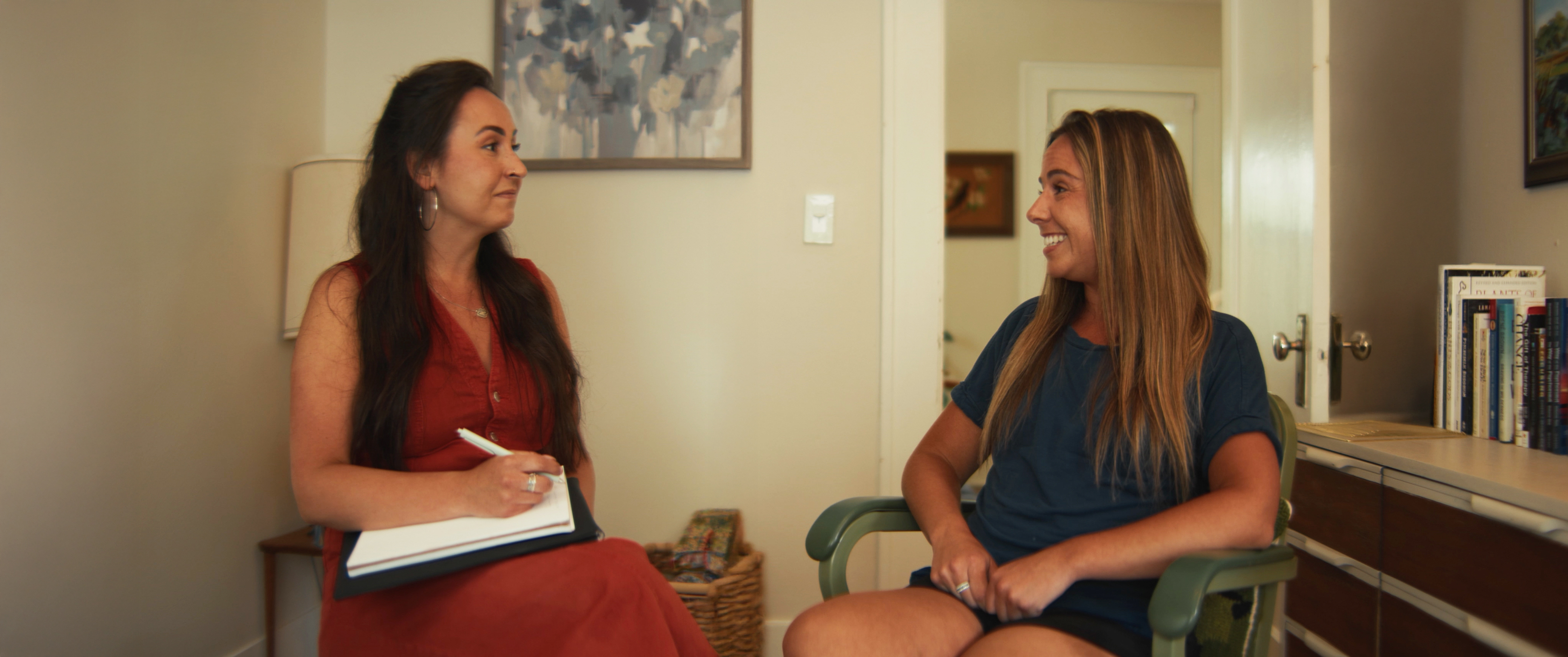
Safety is our highest priority. Psilocybin experiences can be extraordinarily powerful, and we believe they should be met with intention, care, and respect. So we've considered safety at every step of the Odyssey process — here's how.
- Rigorous medical screening removes or reduces most risk before a session ever begins.
- In controlled settings, serious adverse events are very rare — fewer than 1% of research participants reported any lasting negative effects.
- A trained facilitator stays beside you the entire time, using the non-directive approach proven in clinical trials.
- Integration support is built in afterward — and extended at no extra cost if challenges persist.
Step one
Screening & intake
The screening process is one of the most important parts of staying safe. Our in-depth, professionally designed intake means many of the potential risks of a psilocybin experience are reduced — or removed entirely — before preparation even begins.
We reduce or remove most risk before preparation begins — by reviewing medications, cardiac history, and personal and family mental-health history against clinical-trial best practice.
Medications & supplements
Some prescription medications interact with psilocybin.6 Most aren't dangerous — a few can simply soften the experience. Lithium is the exception: it's the one interaction with a real safety risk, so if you've taken it in the last 30 days, we can't proceed, in line with Oregon Health Authority rules.4
Physiological safety
Psilocybin is generally well-tolerated by the body.7 It can mildly raise heart rate and blood pressure, so we take extra care — sometimes asking for physician clearance — with anyone who has a history of cardiac conditions.
Psychological safety
Because an intense experience can, in rare cases, trigger certain conditions, we ask carefully about personal and family history of schizophrenia, bipolar, and other psychotic disorders — the same criteria used in clinical research.12
 What the evidence says
In controlled settings, the safety record is strong.
Decades of research, across thousands of sessions, point the same direction — especially with screening, preparation, and professional support in place.21
of 360 research participants had lasting negative symptoms — and those resolved with support19
doses safely given in controlled settings since the early 1990s22
U.S. adults studied, with no link found to mental illness23
During & after
Held the whole way
The single biggest factor in a safe, positive journey is the person guiding it. We choose facilitators first for a warm, steady, compassionate presence — and we use one simple test: would we send a close family member to work with this person? For every facilitator at Odyssey, the answer is yes.
They follow a non-directive approach — the same style used in modern clinical trials — offering grounded support without steering your experience.28 And the support doesn't end when the medicine does. Integration — turning insight into lasting change — is built in: a full day of it on retreats, and two one-on-one calls after private sessions.
If something harder surfaces and lingers, we stay with you — extending additional support, including financial assistance, at no extra cost. You are never left to process alone.
References & sources
- 4Nayak et al. (2021). Classic psychedelic coadministration with lithium is associated with seizures. Pharmacopsychiatry. View study →
- 5Oregon Health Authority. OAR 333-333-4000 — psilocybin services application process. View study →
- 6Nichols, D. E. (2016). Psychedelics. Pharmacological Reviews. View study →
- 7Johnson, Richards & Griffiths (2008). Human hallucinogen research: guidelines for safety. J. Psychopharmacology. View study →
- 12Morton et al. (2023). Risks and benefits of psilocybin use in people with bipolar disorder. J. Psychopharmacology. View study →
- 17Carbonaro et al. (2016). Survey of challenging experiences after psilocybin mushrooms. J. Psychopharmacology. View study →
- 19Studerus et al. (2011). Acute, subacute and long-term effects of psilocybin in healthy humans. J. Psychopharmacology. View study →
- 20Yaden, Earp & Griffiths (2022). Ethical issues regarding nonsubjective psychedelics. Cambridge Quarterly of Healthcare Ethics. View study →
- 21Aday et al. (2020). Long-term effects of psychedelic drugs: a systematic review. Neuroscience & Biobehavioral Reviews. View study →
- 22Ross et al. (2016). Psilocybin for anxiety and depression in life-threatening cancer (RCT). J. Psychopharmacology. View study →
- 23Krebs & Johansen (2013). Psychedelics and mental health: a population study. PLOS ONE. View study →
- 27Doyle et al. (2022). Hallucinogen persisting perception disorder: a scoping review. Expert Opinion on Drug Safety. View study →
- 28Bogenschutz & Forcehimes (2016). A psychotherapeutic model for psilocybin-assisted treatment. J. Humanistic Psychology. View study →
- 29Griffiths et al. (2016). Psilocybin decreases depression and anxiety in cancer patients (RCT). J. Psychopharmacology. View study →